Let’s talk about filing a TM application without any help first.
There is no doubt that any US person, including legal entity having address in the U.S., can file a trademark application without absolutely no help.
The government agency handling trademark registration, the USPTO, provides ample resources including video clips to guide you through the process.
Although the form itself is not as user-friendly as it could be, you can do it yourself without any prior knowledge or experience.
Nonetheless, it’s not about simply filling the form.
You ought to consider many things before filling out the application form. From what can be trademarked to how it should be trademarked, there are many questions that you should ask yourself before you start filling out the form. The USPTO provides all relevant information, but you can fill out the form without studying them.
The thing is that all online fee services that charge flat fees ask you to choose on your own if you want a basic service or a more through service. How are you supposed to know?
When I prepare trademark applications for my clients,
I see cases where I end up charging only $200 for attorney’s fees in addition to the then-TEAS Plus fee of $225. That’s about on par with the online trademark services.
As I internally process all the questions a client should ask and ask the client only what must be answered by the client, the client might not know how much time and money is being saved. Some attorneys charge for those hidden time and money savings. That explains why they are more expensive than those largely automated trademark services via online.
I tend to talk to clients a lot, and some clients have tons of questions. I think they benefit more from my service. In fact, if you just want it to be filed and move on, you might benefit from automated services as I am not available 24/7.
적어도 미국은 제도적, 행정적으로 누구나 아무런 도움 없이도 스스로 상표 등록을 처음부터 끝까지 진행할 수 있습니다.
금년 들어, 국외 기업/개인은 미국내 대리인을 지정하도록 요구되었지만, 이는 일부 국가 (특히 중국) 기업들의 정부 보조금(실비 100% 지원)에 기반한 출원이 급증한 이후 만들어진 규칙으로, 말 그대로 국외 출원인에 대한 특별 조치입니다.
실제로 미특허청에서는 민원인을 위한 교육자료를 무료로 제공하고 있을 뿐만 아니라, 전문가가 아닌 사람도 충분히 절차를 이해하고 진행할 수 있도록 모든 공식 문서에 절차에 대한 소개와 함께 대응 방법에 대한 제안과 안내를 포함시키고 있습니다.
따라서, 누구나 상표를 스스로 등록할 수 있습니다.
하지만 그렇다고 단순히 양식을 기입하는 것만으로 끝나는 건 아니겠죠.
양식을 기입할 줄 아는 것과 실제로 상표 등록 업무를 제대로 할 수 있는 것은 전혀 다른 이야기 입니다.
온라인 대행 업체는 대부분 양식을 처음 접하는 일반인도 필요한 정보를 빠뜨리지 않고 기입할 수 있도록 도와 줍니다. 그에 대한 대가로 보통 $100 이하의 수수료를 요구하죠. 그렇게 나쁜 거래는 아니라고 생각합니다.
정말로 제대로 된 상표권을 취득하시기 위해서는 고려할 점이 많습니다.
상품 및 상표의 종류나 형태부터 사용방법까지 상식적으로 느껴지는 부분부터 시작하여 disclaimer 나 international class 와 같이 생소한 부분까지 모든 면에서 면밀한 검토를 하지 않고 진행할 경우, 제대로 된 상표권을 확보하지 못할 수 있고, 이는 이후에 상표가 크게 성공했을 때 후회해도 돌이킬 수 없는 일이 됩니다.
대부분의 업체에서 채택하고 있는 단일 요금 (flat fee) + 추가 비용 부가 서비스 (optional extra charge service) 방식은 해당 상표에 대해 어느 정도의 검토가 필요한 지 알 수 없는 소비자가, 검토의 깊이를 결정해야 한다는 측면에서 문제가 있습니다.
사실 저희가 업무를 진행하다 보면,
단순한 케이스의 경우 정부 수수료 $225 에 변호사 비용 $200 정도로 등록까지 마무리 되는 경우도 있어서 누가 검토를 하는지 알 수 도 없는 서비스에 비슷한 비용을 지불하는 건 사실 합리적인 선택은 아닐 수 있죠.
아무래도 저희는 모든 고객에 맞추어 업무를 진행하기 때문에, 진행이 더딜 수 있고 고객 입장에서도 여러가지 정보 및 자료 제공에 시간과 신경을 쓰게 됩니다. 비용도 더 싸지는 않겠죠.
하지만, 특히 궁금하신 게 많고 절차에 적극적으로 참여하고 싶으신 고객분들은 무료/무제한으로 제공되는 상담을 잘 활용하셔서 결과적으로 큰 이득을 보시는 것 같습니다.
글씨만으로 이루어진 상표는 이름 자체를 등록하면 되지만, 그림이 포함되거나 해당 글씨를 표현하는 고유의 스타일이 있는 경우에는 조금 복잡해집니다.
상표의 대표적인 예로 코카콜라가 있죠. 코카콜라 컴퍼니의 대표적인 음료 브랜드인 코카콜라는 “코카콜라” 라는 이름 자체만으로도 너무나 유명하지만, 독특한 스타일의 표현 방법이 더 익숙합니다. 이렇게 고유의 스타일을 가진 상표는 글씨만으로 이루어진 상표와 구분하여 등록해야 합니다.
최근 디지털화로 인해 단순한 이름 보다 독특한 이미지와 색을 이용해 차별화 하는 경우가 많은데 이러한 경우 단순히 이름만 등록하는 것 보다는 고유의 스타일에 대한 권리를 확보해 두는 편이 좋습니다.
허나 일반적으로 등록 시에는 글씨만 하는 경우가 많습니다.
첫째로, 글씨를 등록해 두면 이름 자체에 대한 권리를 갖게 되므로 그 표현 방식이 어떠하든 간에 경쟁사는 해당 이름을 사용할 수 없습니다.
또한, 고유의 스타일로 등록을 하게 되면 로고의 디자인을 변경할 때 마다 상표를 새롭게 등록해야 하는 불편함이 있죠. 실제로 신규 브랜드나 업체의 경우 로고 디자인이 자주 변경되는 경우가 많습니다.
이와 같은 이유로 보통 Standard Character Mark (글씨만으로 이루어진 상표)가 선호됩니다. 허나 이 때 Standard Character 로 표기할 수 있는 문자는 알파벳/숫자/특수기호로 이루어진 목록에 한정되고, 한글은 이 목록에 포함되어 있지 않습니다.
국어 상표의 경우, 영문 표기를 등록하는 방법도 있지만 경우에 따라 전혀 다른 영문 표기로도 같은 국어 단어를 표현할 수 있어서 문제가 됩니다.
그 외에도 고유의 스타일로 등록할 때의 장점이 존재합니다.
IPfever.com 에서 라는 상표를 사용하고 있다고 가정해 봅시다. IPfever.com과 무관한 일본어 및 문화를 공유하는 커뮤니티 웹사이트에서 라는 상표를 이용하기 시작합니다.
일본을 표현하기 위해 JP 그리고 일본 문화에 대한 애착을 표현하기 위해 Fever라고 이름을 지었다고 해도, 이 두가지 상표는 너무 유사하여 혼동을 줄 수 있습니다. 상표권 위반이죠.
그러나, 만약 IPfever를 글씨만으로 등록해 두었다면 이야기가 조금 달라질 수 있죠. 일단은 fever라는 단어는 IPfever 만의 고유한 명칭이 아닌 뜻을 가진 영단어이기 때문입니다.
따라서 적절한 등록 방식을 선택을 하는 것이 중요합니다.
비용이 문제가 되지 않을 경우에는 두가지 모두 등록하는 방법을 생각해 볼 수도 있죠.
허나 Standard Character Mark의 등록이 아예 어려운 경우도 존재합니다. 예를 들어, 커피전문점에 대한 상표로 “The Coffee House” 를 등록하기는 매우 어렵습니다. 왜냐하면 사람들이 비슷한 상점을 지칭하기 위해 흔히 사용하는 말이기 때문이죠.
물론 아래와 같은 고유의 스타일을 등록하는 것은 가능합니다.
물론 이 때 글씨에 대해 권리를 주장하지 않는 다는 내용의 disclaimer 가 필요하죠. 이러한 고유의 스타일을 등록해 두면 아래와 같은 모방에 대해 적절히 대응할 수 있습니다.
Obviousness is a very common reason for rejection.
A grant of patent without a single rejection is quite uncommon. One of the reason is that most applicants want to claim broadest possible for the greatest protection of law.
Broadening the scope of claims.
To maximize the scope of your claim, you don’t want to include unnecessary details in your claim. Let’s take a look at an example (from a real patent). You don’t have to read it through, just scheme.
[an excerpt from US8143982B1, bold added]
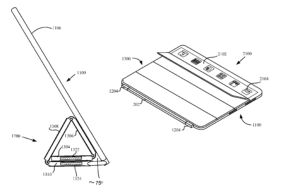
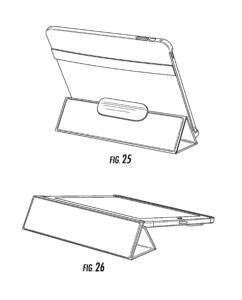
always easier to understand the claims with drawings
1. An accessory unit, comprising:
a hinge span, the hinge span including a first magnetic element suitable for magnetic attachment to a host unit having a display; and
a flap portion pivotally connected to the hinge span, the flap portion comprising:
a plurality of segments all but one of which are substantially the same size and wherein one segment is wider than the other segments, wherein each segment includes a pocket that is about the same size as the corresponding segment,
a rigid insert incorporated into each pocket, the rigid insert providing support for the associated segment, and
a folding region between each of the segments arranged to allow the plurality of segments to fold with respect to each other, wherein a first segment is located at a first end of the flap at the hinge span and includes a magnetically attractable element and wherein a second segment is located at a second end of the flap opposite the first end and includes a plurality of magnets, wherein in a first folded configuration the flap portion forms a triangular structure when the first and second segments are folded one atop the other such that at least one of the magnets in the second segment magnetically attract the magnetically attractable element in the first segment, wherein the first and second segments that are folded one atop the other and magnetically attached to each other form one side of the triangular structure that is about equal in width to a second side of the triangular structure each of which is narrower than a third side of the triangular structure.
[end of claim 1]
What’s claimed?
By looking only at highlighted words, you can figure out that it has two main components, a hinge span and a flap portion, and the flap portion has three sub-components, a plurality of segments,a rigid insert for each segment, and a folding region between each of the segments.
What do you make out of it? Well, it’s iPad Smart Cover by Apple.
Let’s look into the details.
A hinge span is described as follows: including a first magnetic element suitable for magnetic attachment to a host unit having a display.
It doesn’t say a magnet or a tablet PC. Instead, it says a magnetic element suitable for magnetic attachment and a unit having a display, respectively. If it said a magnet, someone can make a cover with a lodestone instead of a magnet and avoid infringement. The same thing goes to the tablet PC.
But, why not just an element suitable for attachment? I think that would be the track which leads to the obviousness trap. Granted it would expand the scope, it also eliminates an outstanding element from the invention. Every cover has some element for attachment.
On a side note,
what about a unit having a display? Why not a unit having a flat surface? Well, Apple is an electronics company, and it probably wouldn’t make a cover for your photo frame. In that sense, a display pretty much is everything that needs to be covered in Apple’s patent.
Infusing non-obvious elements into claims.
Skipping forward to the bulky section, a folding region, can you guess why in the world it is so long? Well, you guess it’s important, right?
This is the section that makes this cover distinct from any other cover design within people’s mind (at the time of invention, of course). It describes how the segments of a cover fold and magnetically bind together to form a rigid stand that can support a host unit. So, you have to describe it fully.
By the way, a cover that folds into a stand is not an invention by Apple. Search Google Patents “US8960421B1” and you will see a prior patent filed by Incase Designs Corp. that has almost identical folding functionality.
Let’s take a look at a claim by Incase Designs [excerpt from US8960421B1].
1. A cover for an electronic device comprising:
a rectangular front cover comprising first, second, and third panels between a first edge and second edge of the front cover, wherein the first panel is closer to the second edge than the second and third panels, the second panel is between the first and third panels, and the third panel is adjacent the second panel,
between the first and second panels is a first hinge, and
between the second and third panels is a second hinge;
a back cover, coupled to the front cover, which will retain the electronic device in the case; and
[It goes on, but let’s stop here.]
So, a flap portion of Apple patent can’t overcome an obviousness rejection by itself despite the elaborated manner of how segments fold and get attracted together to form a stand; that’s where the magnetic element for attachment comes into play. This magnetic element obsolete a back cover, which is listed in the Incase Designs’ patent claim.
Here’s an important question: if Incase Designs knew a way to make a cover without a back cover, would its claim include the back cover element in the claims?
The fact that Incase Design included the back cover element in the claim supports the non-obviousness of replacing a back cover with a magnetic element.
You can read more about this in “Including an unnecessary element in the claims.”
How to deal with an obviousness rejection.
After a careful thought and drafting an application, you can still get a rejection based on obviousness. In this case, you can try again, or get help from patent attorneys.
Patent Specification in your application is the body of your application.
Your patent claims will be read in the context of the specification. Therefore, the specification should include all the information necessary to figure out what you claimed in your patent claim(s). Roughly speaking, it should be an all-inclusive manual for your invention.
It’s part of the deal you’re making with the public.
You’re disclosing your invention to the public, and in exchange you’ll be granted a monopoly for a limited time. To ensure fairness in this deal, you’re required to fully and comprehensibly disclose your invention without hiding anything.
You should focus on making the invention available to the public.
If you want to hide something from the public, you’re free to do so by opting out from disclosing it, in which case you shouldn’t claim it either. However, you shouldn’t attempt to hide even a minute detail of your claimed invention because it can invalidate your patent retrospectively.
For example, let’s say you know two ways to make your invention. You know one works better than the other, but you don’t want people know about the better one. If you disclose the other one only, the patent will be held invalid.
If you don’t claim it now, you may lose it forever.
You may be tempted to include everything you know in your patent application because it would make sure you disclose adequately. Be careful when you include something in your disclosure which are not claimed. Filing a patent application is considered a publication. If you publish something, you will have a year to file a patent application for it. After that, you can’t patent it.
There’s much more.
Although you can learn a lot from the patent applications you found during your clearance search, it’s still not a perfect guide for your specification. To understand your claim, one must read the specification. For this reason, asking an attorney who reviewed your claim(s) to review your specification could be a lot less time-consuming than you think. You don’t need to pay for the separate availability retainer in that case. Just talk to the lawyer who reviewed your claim(s).
Patent claim in your application defines your invention.
And it will determine the scope of your legal rights. In other words, it will tell the others what can be done and cannot be done without infringing your patent right.
Read the claims written by professionals.
By the time you start drafting your application, you probably read at least a number of patent applications. And if you did with care, you would’ve noticed the peculiar but consistent writing style. In fact, you must follow a specific set of rules created by the USPTO when writing claims.
Pay attention to details including punctuation and spacing.
You shouldn’t worry about plagiarism. Use the wordings and grammar (including all formalities) that you see in the patent applications that are granted. Don’t be creative and get rejected.
What about the substance?
Patent applications often have multiple claims, and a claim likely has a multiple components.
The wordier the better?
No. If you include a non-essential component in your patent claim, your competitor can avoid infringement by making a product without the component.
Then, as little as possible?
That’s another no. If there is an alternative material or device which you left out, it could lead to an easy design-around for your competitor.
There’s much more.
To be honest, it is not an easy task to write a good claim. For example, patent law distinguishes “comprising” and “consisting.” If you say your fuel additive consists of chemical A and chemical B, you are telling that there’s no other chemical than A and B. “Comprising” is, on the other hand, open-ended.
Should you know all these technicalities? Well, if you want to become a patent practitioner. Otherwise, it’s more efficient to have a patent practitioner take a look at what you wrote. If your invention is not too complicated, the review shouldn’t take too long.
It’s just that the law firms, boutiques, or their likes practicing patent law are focused on serving bigger mostly corporate clients rather than individual inventors.
When it comes to an invention which is more about an idea and less about technology, you don’t need PhDs spending hours reviewing the art let alone attorneys.
In addition, firms charge more money per hour for small clients than those bigger corporate accounts that generate vast volumes. You can’t really blame them as that’s how business works, but it’s unfortunate that there are few options for individuals and small businesses.
There are alternative, smarter ways to work with attorneys thanks to the internet.
It won’t be easy to find them because the internet search usually shows heavily advertised service first, which can be cheap but not necessarily a better deal. At all times, make sure that you’re working with a patent attorney/agent who’s registered with the USPTO.
There’s utility patent, which is basically what you think patent is. And there’s design patent, which is somewhat unpopular but got the attention when Apple sued Samsung for infringing its design patent.
These two types likely cover all your needs. If you want to protect the cosmetic features of your product, consider design patent. For all other cases, you’ll be thinking a utility patent.
To add, if your design feature has a utility in it (i.e. when your new design serves a function), then you will probably have to go with a utility patent.
You found nothing like yours in your Google Patents search, and you might feel ready to patent your new idea. It’s not that simple.
First, your invention should be new in a sense that people don’t know it yet.
Even if nobody really patented an idea, the idea might be known to many as a common sense or to a small number of people known as experts or scholars. It doesn’t matter how many people know it.
When you go into detailed analysis, it gets more complicated. Let’s say your company is the first to sell a mouse pad made of bamboo and you want to patent it.
The bamboo is obviously not a new material; it’s not even a man-made material. Clearly, it’s not something you can consider an invention.
Similarly, a mouse pad is not a new thing. It’s been made of many different materials and widely used in personal computing.
Now, a mouse pad made of bamboo? Let’s further assume nobody on the planet Earth ever made or used a mouse pad made of bamboo. Is it new then?
Unfortunately, it’s not. The law will not only look at the things that already exist but also guess what can be done with existing technology and skills. I mean bamboo is a sturdy and hard material that can be easily shaped into a small plate. The law will likely say that your new idea of making a mouse pad with a bamboo was obvious. Basically it’s saying that “we don’t need an inventor to do that.”
Second, you have to fit your idea into certain categories that can be patented.
The law provides a short list: process, machine, manufacture, or composition of matter. If you think about it, it’s pretty broad. In the above example, we discussed a bamboo mouse pad as a manufacture, which we concluded not patentable.
However, you may have a ground-breaking manufacturing method to process a raw bamboo tree into a large plate that can be easily cut into any shape of mouse pads. Well, that might be a patentable “process”.
We can go further. If you designed and made a machine for the processing of raw bamboo trees, you may patent the machine as long as it satisfies other requirements. As you can guess, inventors often patent a manufacture, the process of making it, and the machine that performs the process at the same time.
Lastly, your idea has to have a purpose.
This is usually not a concern because the law doesn’t ask for a good one. If you can find a single use for your invention, that’ll be fine. The use doesn’t have to be new or better than others. In fact, even if your method of processing bamboo turned out to be too expensive to make economic sense, it still has a utility in the eye of the law.
Maintaining registration calls for both administrative and executive action.
Administratively, you need to file with the USPTO a showing that you’re still using the mark after 5 years of the registration, and every 10 years, you need to file a request for renewal.
On the business side, you must continue using your mark at all times, even after the registration. This requirement is often overlooked because your staff who handles trademark typically has no saying in continuing/discontinuing a product line.
You need to monitor your registration status and enforce your trademark rights yourself.
Trademark Status and Document Retrieval (TSDR) service offered by the USPTO is a good place to start. The USPTO recommends every trademark applicant to check TSDR regularly.
The USPTO does not enforce registered trademarks for the owners. It’s your obligation to monitor infringing activities in the market and take actions to stop them. Often it involves writing a letter to notify the wrongdoer and ask for compliance/compensation, but you may need to bring a lawsuit if there’s a dispute.