
Opening your inbox to find an “Office Action” from the United States Patent and Trademark Office (USPTO) is enough to make any business owner’s heart drop. If you’re reading this, you’ve likely been hit with a Specimen Refusal.
Before you assume your trademark is doomed or that you need to spend thousands on an attorney, take a deep breath. Specimen refusals are incredibly common. Sometimes, the fix is as simple as following the rules. Other times, the examining attorney simply made a mistake.
Here is your straightforward, layperson’s guide to understanding the refusal and navigating your response.
The Background: What is a Specimen?
To get a trademark registered in the U.S., you can’t just invent a cool name—you have to actually use it to sell things in the real world. A specimen is your proof. It is a real-world example of how your customers see your trademark when they buy your goods or services.
The rules for what counts as a valid specimen are housed in a massive USPTO rulebook called the TMEP (Trademark Manual of Examining Procedure).
- For Goods (Products): The USPTO generally requires the trademark to be on the product itself, on the packaging, or on a tag/label attached to the item.
- For Services: The USPTO requires the trademark to be used in the sale or advertising of the services (like a website screenshot showing the logo and a “Book Now” button).
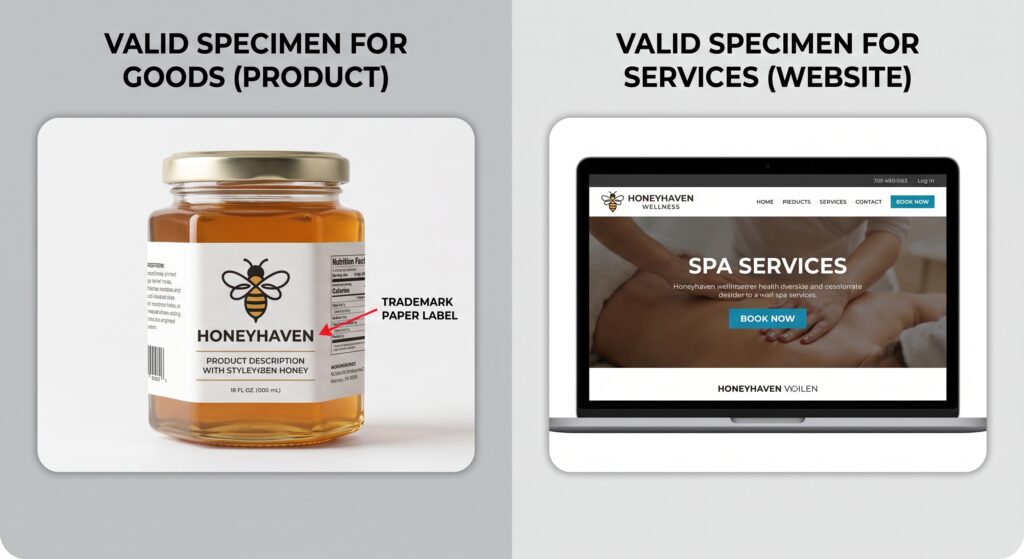
If your examining attorney rejects your specimen, it means they don’t think your photo or screenshot meets the strict TMEP criteria. But examiners are human, and they handle hundreds of applications a month. They don’t always get it right.
Here are the two most common DIY paths to resolving a specimen refusal.
Scenario 1: The Examiner Dropped the Ball
Sometimes, you submit a perfectly valid specimen, but the examiner misunderstands what they are looking at.
I personally had a Trademark Examiner mistake a soap flower for a real flower because it was so sophisticated and realistic. Because the photo image did not reveal the characteristics of the soap flower clearly, we had to submit a substitute specimen. But most of the time, you can simply point out details in the image to explain why the specimen is proper and the refusal should be withdrawn.
How to respond: If your original specimen is completely unambiguous and clearly meets the TMEP rules, you do not always need to file a formal written response using the dedicated TEAS form. You can simply talk to the examiner.
- Find their contact info: Scroll to the very bottom of your Office Action. The examiner’s name, direct phone number, and email address will be listed there. When it’s a clear-cut case like this, an email is most efficient.
- Reach out professionally: Send a polite email stating your serial number and explaining the exact nature of the specimen.
- Example: “Hi Examiner [Name], regarding Serial No. 12345678, the refusal states the specimen appears to be a … You can see … in the top right corner…”
- Wait for a response: If the examiner agrees they made a mistake, they can simply place your email on the record and accept the original specimen without you needing to file a formal response form.
Scenario 2: The Specimen is Ambiguous
Let’s be honest: sometimes the examiner didn’t make a mistake; the photo we sent was just terrible.
Maybe the lighting made the tag look fake, or you zoomed in so far that the product itself is unrecognizable. If your specimen leaves room for doubt regarding its nature, trying to argue with the examiner over the phone is usually a waste of time.
How to respond: When the original specimen itself does not clearly disprove the Examiner’s understanding, the most straightforward way to tackle it is to simply submit a Substitute Specimen.
Instead of arguing that your blurry photo technically qualifies, you just take a better photo and submit it using the USPTO’s “Response to Office Action” form online.
However, there is one major legal catch you must know before doing this:
Substitute Specimens Can’t Be New: You cannot just print a new label today, slap it on a product, and submit it. The substitute specimen must have been in use before a specific date.
- If you filed an “Use in Commerce” (1a) application, the substitute specimen must have been in use before your original filing date.
- If you filed an “Intent to Use” (1b) application, it must have been in use before you filed your Statement of Use.
This is particularly tricky when you submit a webpage screenshot as a specimen. Because you must have accessed the webpage and taken the screenshot before the critical deadline, you can’t simply go online now. In this case, the Wayback Machine can be your savior, although the internet archive does not save all webpages every day.
When you upload the new specimen, the online form will force you to sign a legal declaration swearing under penalty of perjury that the new photo represents how the trademark was used prior to that critical deadline. As long as you have an older, clearer photo—or the product has looked the exact same since before you filed—submitting a substitute is usually a quick, clean fix.
The Bottom Line
Receiving an Office Action is a roadblock, not a dead end. Look closely at the specimen you submitted. If it’s crystal clear and the examiner just missed the mark, a well-reasoned friendly email might solve your problem. If the specimen left some doubt, skip the argument, get a better specimen that meets the date requirements, and submit a substitute.
If a better specimen cannot be obtained, you might need to support the original specimen with an argument and a formal statement signed by a person with personal knowledge, and so on. That would be something you want your lawyer to handle.
Leave a Reply