Category: Trademark

  • Trademark Search Hacks

    Trademark Search Hacks

    • Updated on 2/6/2024 for the all-new Trademark Search by USPTO.

    Trademark attorneys, like myself, use USPTO’s Trademark Search like everyone else. I will walk you through the entire process with helpful tips you can use right away.

    First of all, you need to access Trademark Search (uspto.gov)

    You should see something like this:
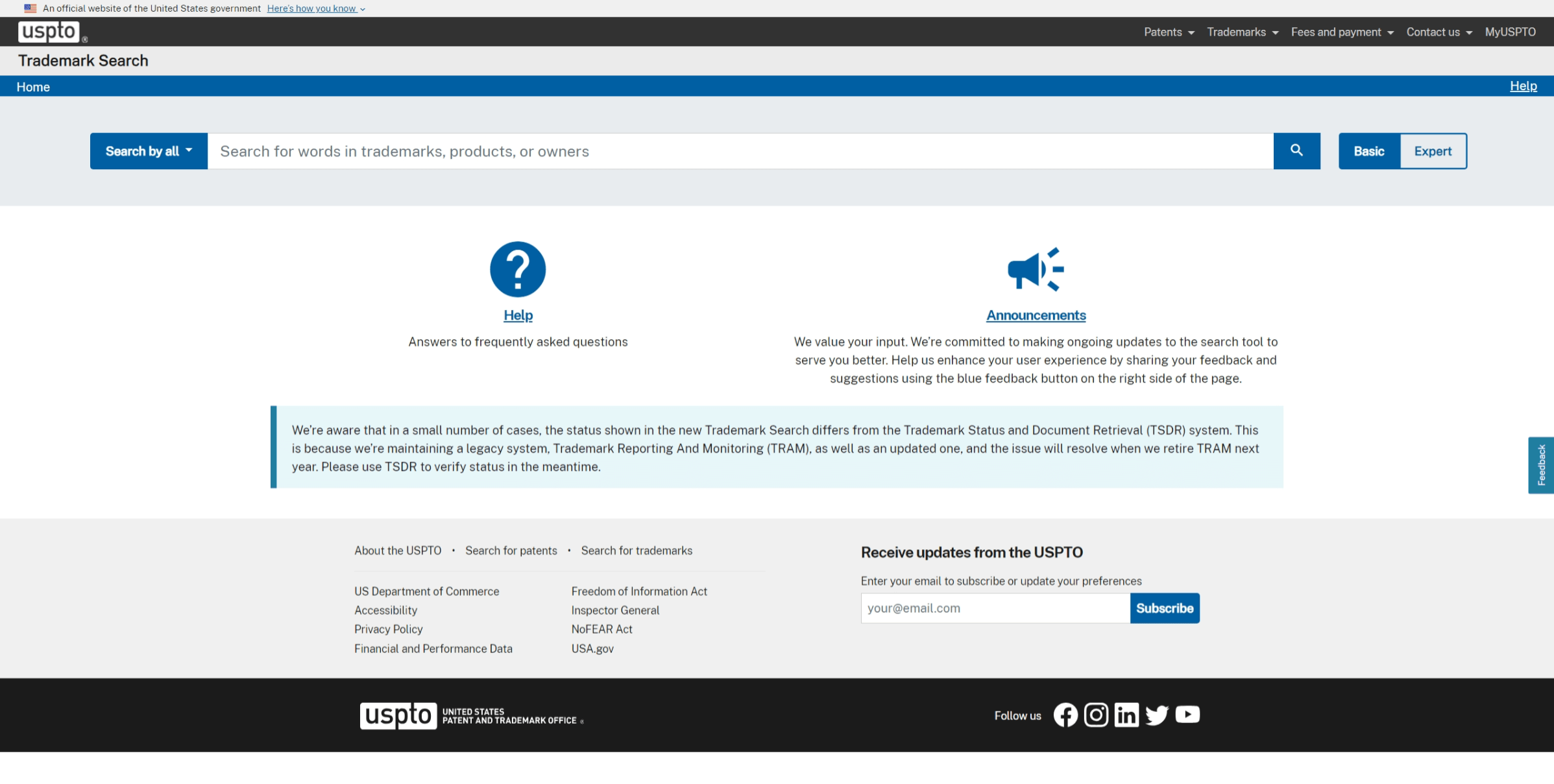
    Now, hit the “Search by all” button on the top left, and choose “Wordmark”.

    If you know what company name (or brand) you’re looking for, you can simply type it here.

    Alternatively, it should give you a good start if you’re concerned about others using more or less same name or design as your brand.

    For example, if you search “apple”, it will show you all trademarks in the USPTO’s database that contain the word “apple” as well as any design related to the fruit “apple.”
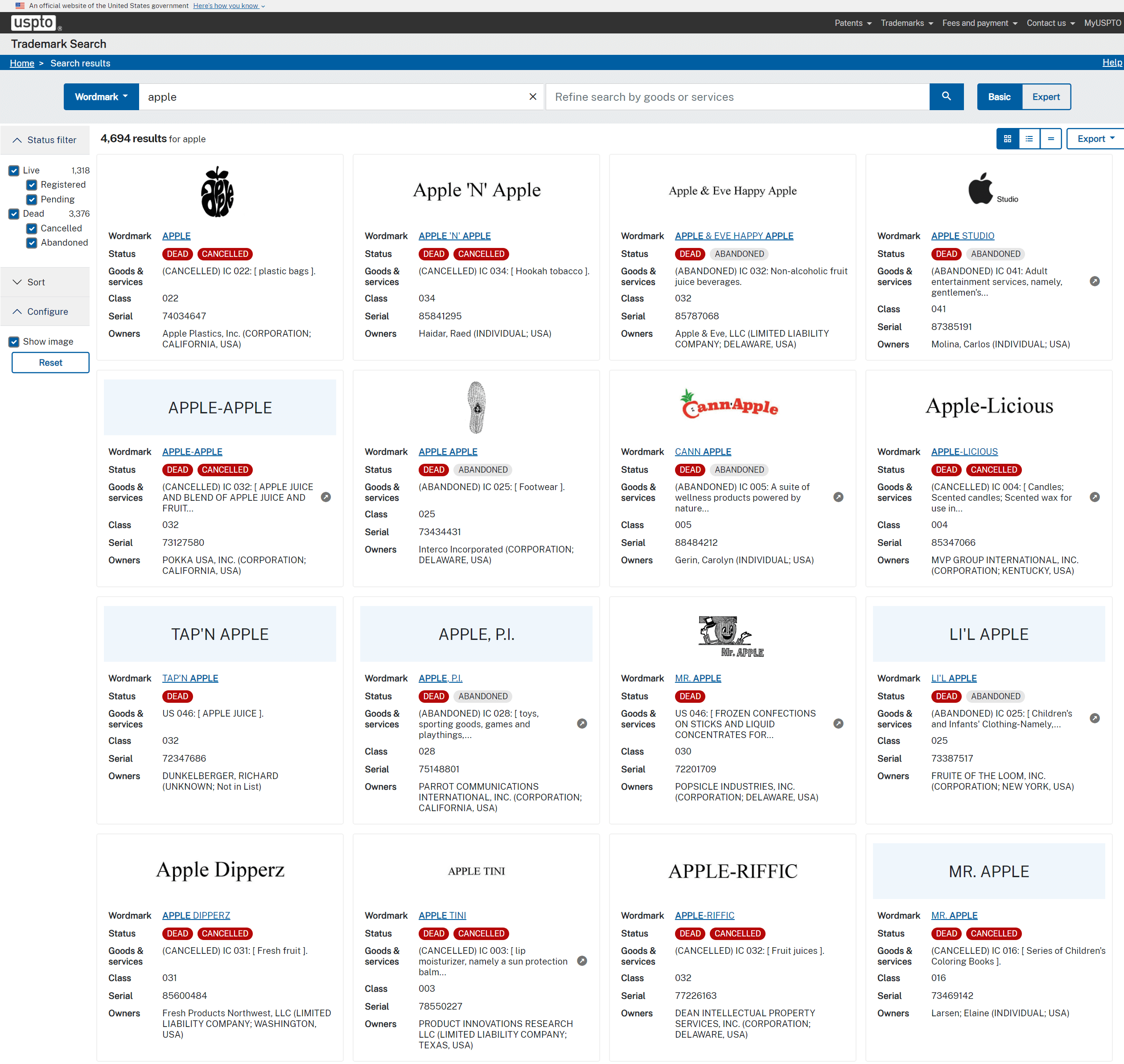
    The above are just the first 16 trademarks out of 4,694 results that I got today.

    Narrow it down using description of goods or services

    Let’s start by saying a trademark can’t stand alone without association with a good or service. When you see a sign saying “Apple” in a grocery store, would you assume that the fruit is produced by Apple, Inc.?

    No. That’s why you should be interested only in the trademarks used in association with the goods/services related to your business.

    You can narrow your search result by typing your own description of a good or service. Just locate a new box, pre-filled with the title “Refine search by goods or services”, next to the search box you just used.
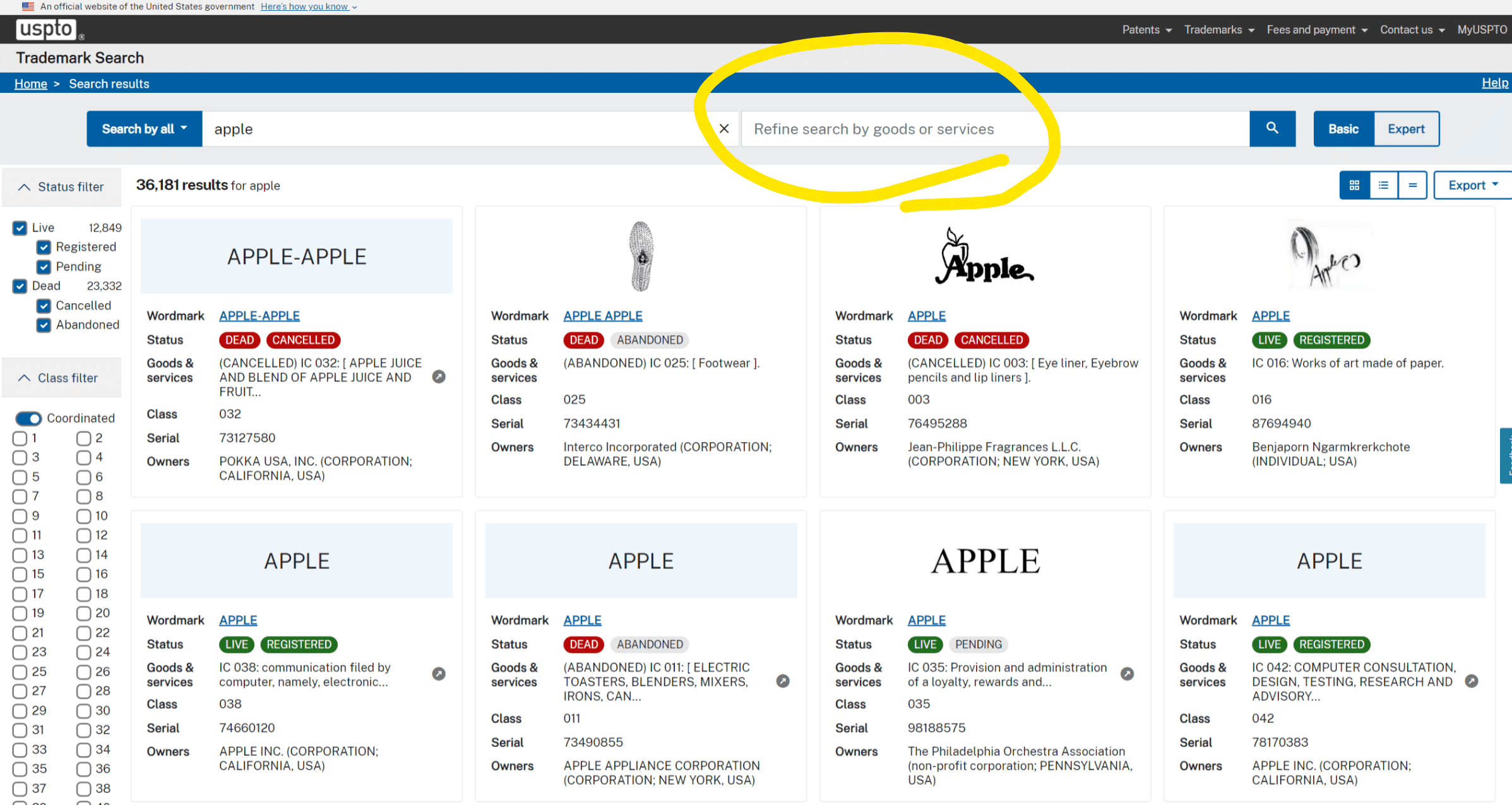
    You can, for example, search “socks” if you’re in the socks business, but that’s when you are interested in pretty ordinary items like socks.

    Alternatively, use the International Classes

    Trademark examiners are more likely to use International Classes (or ICs) than descriptions like “socks”.

    A brief introduction to the ICs. Countries around the world decided to categorize trademarks into 45 international groups or classes. International Class 1 is for chemicals; 3 is for cosmetics and cleaning preparations; and so on. There are only 45 ICs. Because it’s easy to presume that goods or services in the same category are closely related, when a trademark has a similar mark registered in the same IC, it’s an automatic red flag for trademark examiners.

    Also, you should consider related ICs. For example, meats and processed foods (IC 29) are often sold at the same place as staple foods (IC 30) and natural agricultural products (IC 31). This is covered by “coordinated” feature of the Trademark Search. More about this further down.

    First, it’s a good idea to skim through the list of ICs.

    List of ICs

    1. Chemicals
    2. Paints
    3. Cosmetics and cleaning preparations
    4. Lubricants and fuels
    5. Pharmaceuticals
    6. Metal goods
    7. Machinery
    8. Hand tools
    9. Electrical and scientific apparatus
    10. Medical apparatus
    11. Environmental control apparatus
    12. Vehicles
    13. Firearms
    14. Jewelry
    15. Musical instruments
    16. Paper goods and printed matter
    17. Rubber goods
    18. Leather goods
    19. Non-metallic building materials
    20. Furniture and articles not otherwise classified
    21. Housewares and glass
    22. Cordage and fibers
    23. Yarns and threads
    24. Fabrics
    25. Clothing
    26. Fancy goods
    27. Floor coverings
    28. Toys and sporting goods
    29. Meats and processed foods
    30. Staple foods
    31. Natural agricultural products
    32. Light beverages
    33. Wines and spirits
    34. Smokers’ articles
    35. Advertising and business
    36. Insurance and financial
    37. Building construction and repair
    38. Telecommunications
    39. Transportation and storage
    40. Treatment of materials
    41. Education and entertainment
    42. Computer and scientific
    43. Hotels and restaurants
    44. Medical, beauty and agricultural
    45. Personal and legal

    Nice Classification (wipo.int). Italics are added to indicate services.

    Incorporating ICs into your search is so easy although it’s called “Expert”. You only need to click the button “Expert” next to the search boxes.
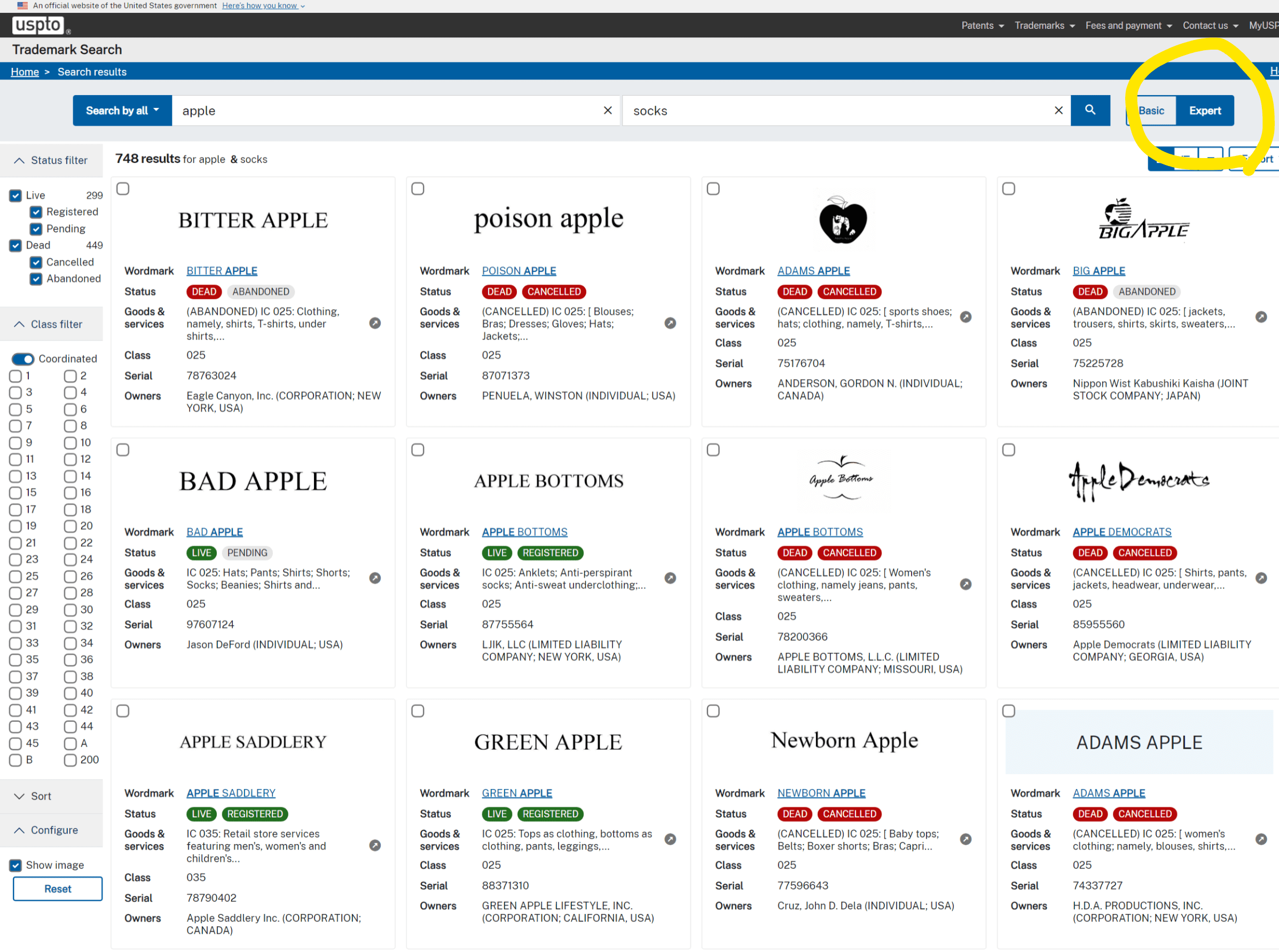
    Now you can see the list of ICs on the left column. You only need to click on the ICs you’re interested in.

    You probably already found this, but there’s a “Coordinated” toggle above the list of ICs. When you select an IC, some ICs will be automatically selected in a lighter color, if the toggle is on. These are ICs that the USPTO deems related to the IC you selected.
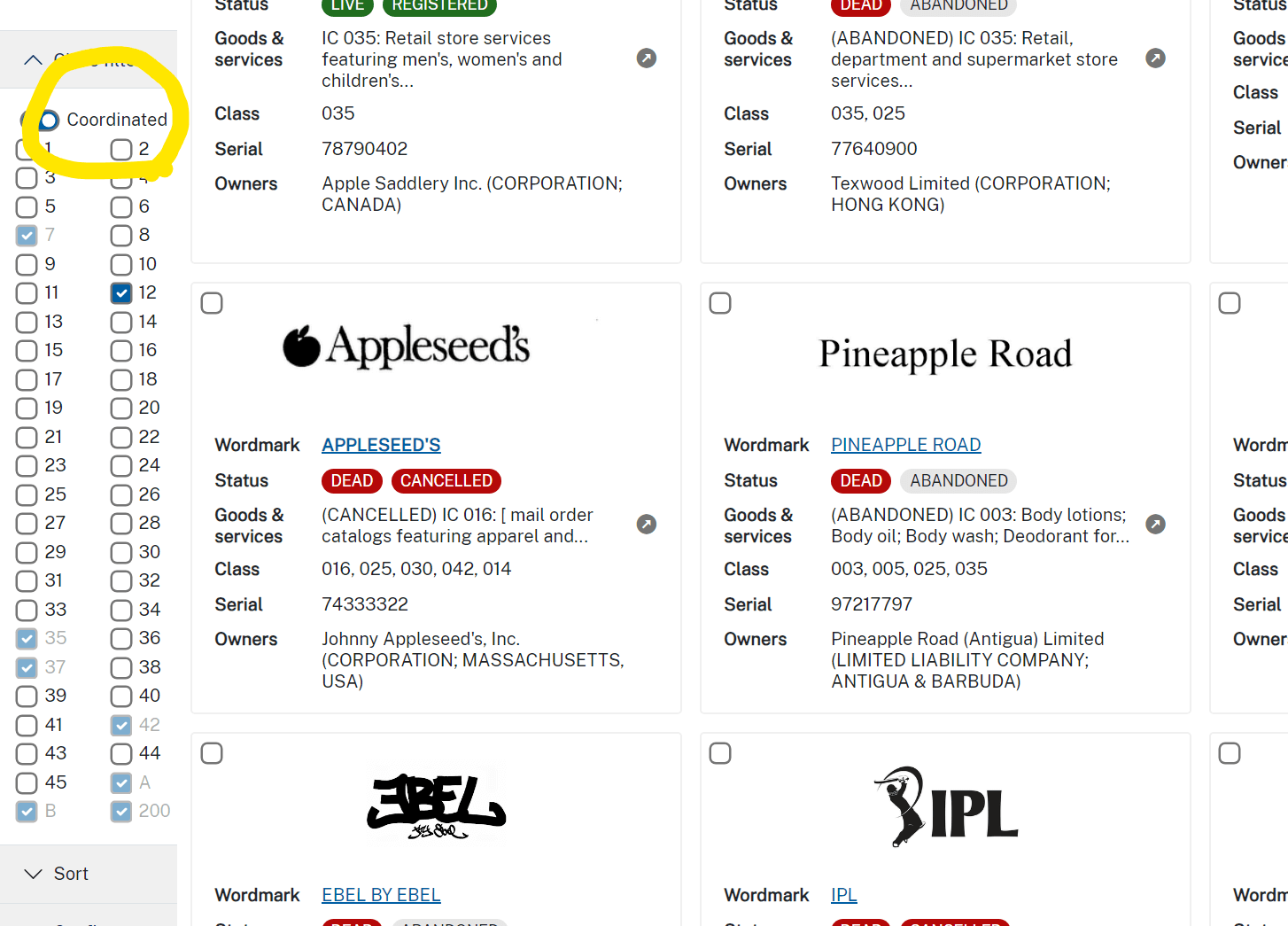
    You can play with other toggles such as “Live” and “Dead” in the “Status filter” above to further narrow down the search.

    Advanced search

    Unfortunately, people don’t always use correct spellings for brand names. Sometimes, the number “0” may replace “o” in a trademark, making your search incomplete.

    Trademark Search offers you an option to use Regular Expression (Regex) instead of simply typing “Apple”, but this calls for the use of “FIELD”.

    I put FIELD in all-caps because “fields” should always be capitalized in Trademark Search. So are Boolean operators like AND and OR.

    Start with a CM FIELD.

    Combined Mark FIELD lets you search not just the words but also alternative spellings and translations.

    First, we want to find out the most distinctive and recognizable part (or parts) of your trademark. We will be calling the part(s) keyword(s).

    If your mark is “T-mobile” for telecommunication services, I would say the keyword is the letter “T”. If your mark is “NinjaBlender” for blenders, “Ninja” would be your keyword. If it’s “Saks 5th” for a retail store, it’s “Sak” and “5th”.

    For made-up words like Noorola, just pick a part that looks familiar, like “rola”.

    You should type in (or copy and past and change KEYWORD to your own keyword):

    CM:/.*KEYWORD.*/

    in the search box after changing the blue box to “Search by filed tag” as shown above.

    e.g.

    If you have more than one Keyword, you can connect them (KEYWORD_1 and KEYWORD_2) with “AND” to find only marks that have both.

    CM:/.*KEYWORD_1.*/ AND CM:/.*KEYWORD_2.*/

    e.g.

    This search pulls up all the trademarks that had been registered and applied as well as currently registered trademarks as long as they include your Keywords. Because we added the regex “.*”, if your keyword is home, the result will include Homedics. However, your search won’t include “fifth”, more about this later on.

    A good thing is that because we used the field “CM”, you will not miss a foreign equivalent of your keyword. e.g. Primera Banco for an equivalent of First Bank.

    Other fields to use.

    I personally try to go through at least hundreds of marks that are most similar. However, on many occasions, the Keyword search populates thousands or more.

    There are many ways to narrow down your search. For example, you can simply see only “live” entries, meaning applications pending examination and active registrations, by adding “AND LD:true” at the end.

    CM:/.*KEYWORD.*/ AND LD:true

    This sometimes helps, but dead applications and cancelled registrations can give you a fuller picture, so it’s not always a good way to perform your clearance search.

    In a similar way, if you want to see only “registered” marks that are live, you can use “SA:registered”.

    CM:/.*KEYWORD.*/ AND LD:true AND SA:registered

    This gives you only registered marks that are still active. If you want to search for every mark that has been registered, including currently cancelled, you can drop the middle part.

    CM:/.*KEYWORD.*/ AND SA:registered

    Incorporate ICs.

    Incorporating ICs into your search shouldn’t be hard. Just remember you should always put them in a three-digit format such as 001, 012, and so on.

    IC:THREE_DIGIT

    For example, you can search IC:001 to see all trademark applications and registrations for chemicals.

    Because we wanted to narrow our search, we should add it to the previous search with a preceding “AND”.

    CM:/.*KEYWORD.*/ AND LD:true AND SA:registered AND IC:THREE_DIGIT

    You can add more than one IC in a search.

    IC:THREE_DIGIT OR IC:THREE_DIGIT

    Note, “OR” is used here because you are interested in both of ICs separately, not just trademarks that are registered for both ICs.

    It’s important to note that if you want to use “OR” in tandem with other fields connected with “AND”, you should use parenthesis to get a correct search result.

    For example,

    CM:/.*KEYWORD.*/ AND LD:true AND (IC:THREE_DIGIT 
    OR IC:THREE_DIGIT)

    I want to remind you that you can always use the “Expert” mode, left column to choose ICs, with coordinated toggle on/off, but the above should illustrate how to perform a nested search with parentheses.

    Now, you have it.

    Before I let you go. A word of caution. The narrower your search gets, the more you will miss.

    Also, in practice, my search gets a little crazy with keywords. For example, I may use

    CM:/h[ou]n[aeiou].*/ 

    instead of

    CM:/.*honey.*/ 

    because I want to include marks like “huneyboo” in my result. FYI, the first regex will return more than double the total search results than the second regex. If you’re concerned about the alternative spellings but don’t know a thing about regex, you stick with the Wordmark search above illustrated.

    If you’re not familiar with regex but want to learn more, just look up tutorials for regular expression, which is more widely used than you think and certainly not an invention by the USPTO.


  • Did you receive an invoice (or a bill) for your trademark?

    Did you receive an invoice (or a bill) for your trademark?

    If you are wondering if the invoice or bill you received by mail is legit, please read on.

    Scammers consistently target US trademark applicants and registrants. Many of those have names bearing a close resemblance to the name of the United States Patent and Trademark Office (USPTO) such as Patent and Trademark Office, LLC.

    First off, if you have hired a U.S. attorney to work on your trademark application, you can safely ignore all but your attorney. The USPTO do not contact trademark owners directly when it has other contacts such as an attorney of record.

    Second, the renewal of trademark registration requires paperwork. You simply cannot extend the life of a trademark registration by just footing a bill. Hence, the USPTO never sends you a bill; instead, it accepts filing fees along with required paperwork.

    Lastly, this goes without saying. But when you are in doubt, do not pay!

  • TM attorney’s brand naming ideas

    Is this a good trademark?

    Well, I get that question a lot as an IP attorney. I have been working on trademark cases for about ten years now. In fact, one of the first things I did as a newly minted attorney in Chicago was to file a response to an office action rejecting a trademark application by YS bee farms.

    Ever since, I’ve been working with small and large businesses to get their trademarks registered or help them enforce or defend their trademark rights in courts. These clients are more or less established businesses.

    Then, Amazon Brand Registry happened, and everyone wants a registered trademark now. Literally, everyone. I get an email from an individual who wants to aspire to become a successful Amazon seller every now and then. Unfortunately, these online retail newbies often ask the wrong questions:

    • How much does it cost to get a registered trademark?

    Well, it depends, if you want just something with ®, it would only cost you $250, seriously. If you want something of value, it can go way up.

    • Are there any requirements to get a registered trademark?

    Well, ironically, the answer is a trademark. You’re registering a trademark you already have! (With an exception of ITU, of course.)

    The question you should ask

    A business experienced in retail always come with brand/name candidates instead of a product label already printed out. They ask me questions like:

    • “Can we use any of them?”
    • “What do you think is the best?”
    • “Are there any conflicting marks out there?

    And the ultimate question: “is this a good one?”

    These are all really good questions. Also, I hear them so often. When it comes to a certain mark there are always specifics that do not apply to other cases. However, there are repeating themes that are sort of universal. I want to discuss some of the universal tips.

    Use TESS

    Your brand name should be remembered. To achieve that, often you resort to tapping into your own memory and experience. Then, you come up with something familiar.

    Now, familiarity is the enemy of a distinctive mark. You don’t want to pick something that has been used by another for many years. In fact, if there is likelihood of confusion between the old mark and your mark, you will be legally barred from using or registering the name.

    TESS is an acronym of Trademark Electronic Search System. It’s a free and powerful tool. You can simply type up your candidate to see if there’s any identical trademarks that are registered, applied-for registration, or cancelled of registration.

    I mentioned likelihood of confusion, which means you should also avoid similar marks. To find similar marks, you can do advanced searches on TESS as well. Advanced search needs some knowledge and practice. But, there are some easy things you can start right away.

    Use $ signs to expand your search.

    Let’s say your brand name candidate is “Aweriginal”. You can try “Awe$” or “$riginal”, which will return anything starting with awe- and ending with -riginal, respectively.

    The dollar sign works fine in the non-advanced search option, “Basic Word Mark Search (New User)”.

    Narrow it down to your market.

    Well, the internet made all trademarks essentially nationwide. In other words, I’m not talking about the geographical market. On the other hand, you can still have identical trademarks used by independent entities. For example, you may use “Aweriginal” for your grocery store while “Aweriginal” has been used for decades by someone else for a beauty salon service.

    Although there is no clear cut answer to what types of good/service can be said to be distinctive (or in different markets), you can more often than not rely on international classes. To narrow your search to a specific international class, you should use “Structured Search”.

    Searching for anything with “awe-” in advertising and business category only.

    In doing so, you can eliminate a lot of candidates that are too similar to already existing marks.

    Use common sense

    If your brand name reminds of someone else other than you, it’s not a good name. If your name tricks a customer into a belief that they are buying from someone else, it goes against the very idea of trademark: it should tell consumers where the good/service comes from.

    Similarly, if your brand name simply tells what the good/service is, it’s not a good name. It should tell where it comes from, but not what it is.

    Tips for good naming

    I digress. This article is actually about how to give a good name. All I said so far is how to avoid bad names.

    So, here are some hacks.

    Tweak spellings

    This is probably all too familiar. Our example “Awerigional” is indeed a tweak of “original” using awe- instead of “o”.

    Use suffixes

    If you are fond of a certain word or common name, you can add suffixes to it for extra distinctiveness. If I were to use my name “Jeon” for a trademark, I would soon realize there are more than 500,000 people with the same name in South Korea alone.

    However, Jeonish, Jeonastic, and Jeonity are all pretty distinctive and easy to remember names if you’re already familiar with the “Jeon” name.

    Make it simple

    A catchphrase is very attractive, but it does not go far legally. It’s not to say that you can’t have a phrase registered as a trademark. In fact, it’s often easier to have a phrase registered than a word.

    However, when it comes to trademark protection, it should not just protect against identical copycats but also against similar rip-offs. As phrases often convey a meaning, your competitors can easily claim that they’re just using the phrase for the meaning.

    So, “it’s so deli-cious” is never be a good name for your delicatessen however tempting.

    Use it properly

    My final advice has nothing to do with naming. Nonetheless, if you’re using a good name the wrong way, it would be shame.

    Don’t refer your product/service by just the trademark. For example, don’t call your specialty raisin bread Aweriginal. It should be Awriginal raisin bread. It’s true even if no other bread in your bakery is called Awriginal.

  • What Do I Need for Trademark Registration?

    What Do I Need for Trademark Registration?

    To register a trademark, you need to either (1) have used a mark (could be a brand name, a company logo, or even a unique color) in association with your good or service or (2) have a bona fide intent to use it.

    How does this translate in plain English?

    (more…)
  • DO NOT PAY WTP!

    DO NOT PAY WTP!

    Many clients reported that they received an unsolicited service invoice from Service BPM 326634 at 8345 NW 66 ST #2000 33166-7896 Miami, which looks like this:
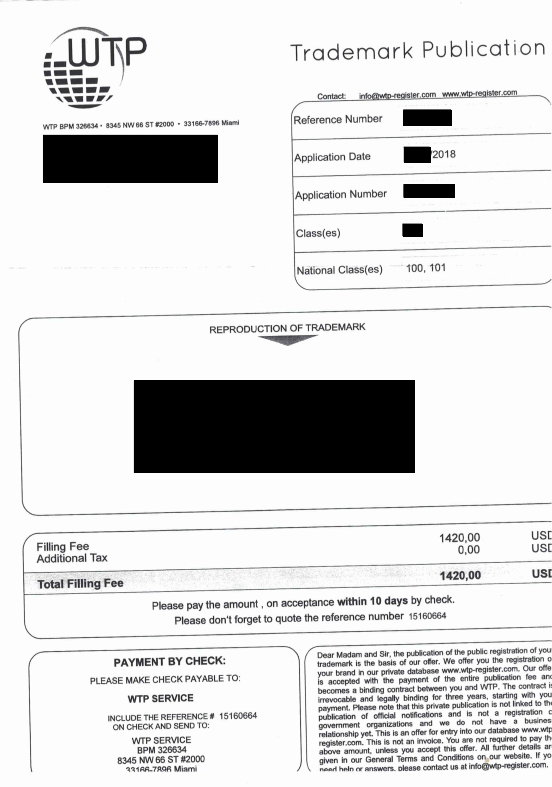
    WTP invoice sample

    It has nothing to do with your U.S. trademark registration, and you are advised to ignore and discard it.

    If you have questions regarding trademark protection in other countries than the U.S., please contact your attorney.

  • USPTO TEAS—What is a disclaimer?

    USPTO TEAS—What is a disclaimer?

    The USPTO has helpful videos and TEAS instructions to help out trademark applicants, but how disclaimer affects your legal rights and potential to be initially rejected for registration via office action?

    Let’s talk about the disclaimer in terms of registrability and trademark owner’s right.

    (more…)
  • How to Avoid Trademark Refusal

    How to Avoid Trademark Refusal

    Just google trademark registration, and you will see a bunch of under-$100 trademark services online. How is it possible? There is a hidden cost of trademark registration: your mandatory response to the USPTO’s initial conclusion that your mark is not registerable. (See Possible Grounds for Refusal of a Mark | USPTO) By the way, this type of office actions are quite common.

    (more…)
  • When should you DIY TM application?

    When should you DIY TM application?

    The USPTO provides ample resources to guide first-time DIY-ers through the trademark application and registration process. However, it does not give you much regarding when and how you should decide to seek expert help. Here comes a seasoned IP attorney’s take on “when should you go the DIY route.”

    (more…)
  • Promotional Phrases as Trademark

    Promotional Phrases as Trademark

    Nowadays, in addition to “maker” and “brand”, “product name” is increasingly used as a trademark. There are simply so many product types and variations. Take a look at an example below:

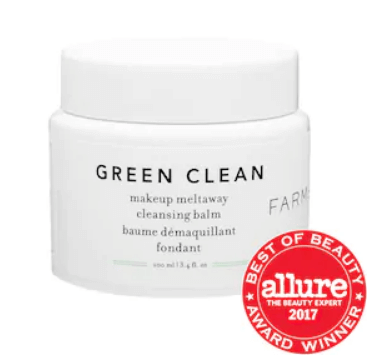
    GREEN CLEAN is a product name of a cleanser from Farmacy Beauty. My impress is that it is something that naturally cleans your skin. It feels natural because of the word GREEN, and I can assume it is a cleansing product because of the word CLEAN.

    Well, this type of phrases well serve the purpose of explaining what the product is in addition to telling it apart from competitors’. However, because of the former, there’s limited protection.

    Descriptive phrases

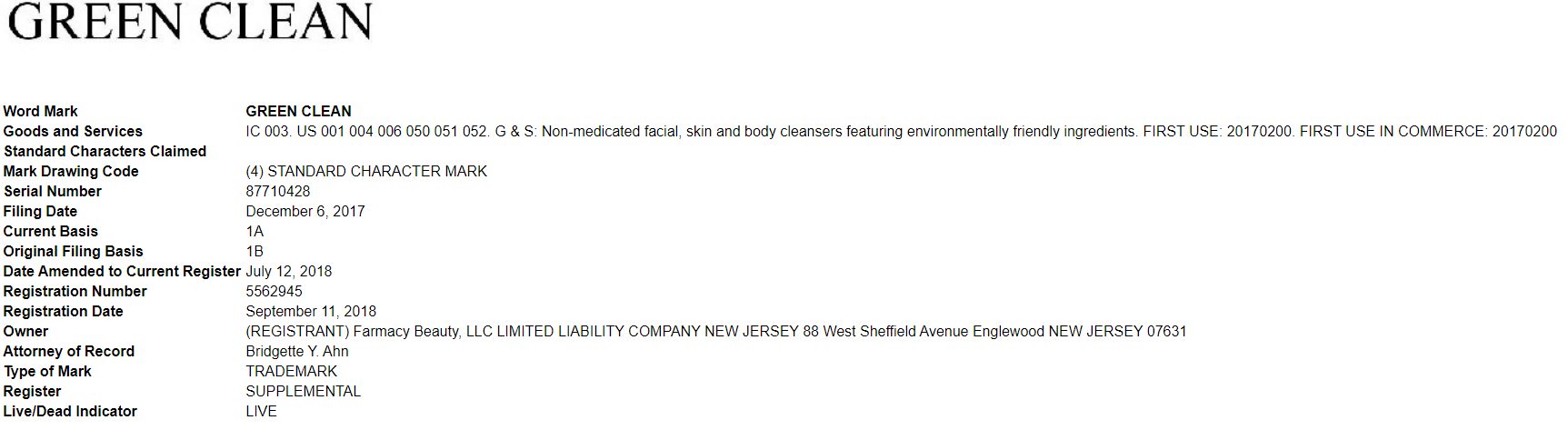
    When your product name simply describes what it is, this cannot be registered on Principal Register but instead you may place it on Supplemental Register, which kind of serves as a waiting list to be registered on Principal Register.

    GREEN CLEAN is no different as belows.

    Why people or companies bother to register their marks on Supplemental Register? It still is a register, and it affords you the right to put ® symbol next to your product name. Other than that, it's a great stepping stone to later register on Principal Register.

    Tough luck if…

    You may be denied of registration altogether on both principal and supplemental register if your description is deceptive. For example, if you want to use the surname Obama for your book club, the USPTO would certainly refuse to register a name such as OBAMA BOOK CLUB.

    When the description might deceive consumers or defraud them, it simply is not a trademarkable name.

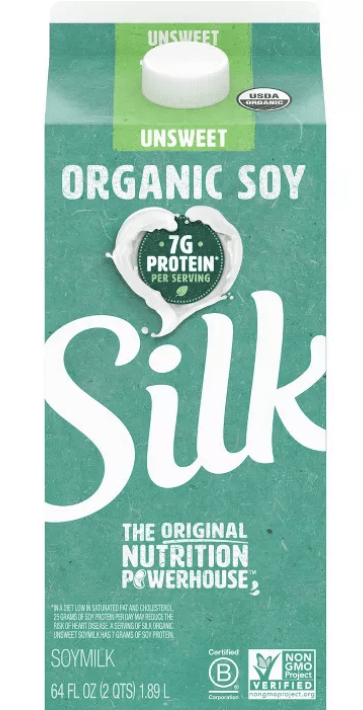
    In reality, though, you will face more issues with characteristics and features of your product or service. For example, let’s say you name your clothing brand SILK THE EXTRA ORDINARY. Then, the USPTO might want to confirm if your clothing is actually made of silk.

    Not a ban

    You can definitely use SILK for your soy milk product.

    Using a descriptive word in a non-descriptive way is actually a great way to create something distinctive without much creativity.

    Of course there are other ways. For example, SILKY may convey a similar meaning while avoiding deception. EXTRA ORDINARILY SILKY may not trigger the same rejection as SILK THE EXTRA ORDINARY though it’s very similar.

    Another example is COPY CALF for artificial leather goods. Although it is not made of CALF, the addition of COPY made it not deceptive.

    It was an obvious play on the expression “copy cat” and suggested to purchasers that the goods were imitations of items made of calf skin.

    A. F. Gallun & Sons Corp. v. Aristocrat Leather Prods., Inc., 135 USPQ 459 (TTAB 1962).

    Last words

    As always, trademark law looks at the perception of consumers, and therefore it’s very subjective. So, you can simply look at a wording to figure out if it’s a good trademark. You should take account of the market/industry, target consumers, and product features together with the wording itself.

  • Amazon Brand Registry related FAQ

    Amazon Brand Registry related FAQ

    Amazon Brand Registry is one of the strongest Amazon selling tools as a seller can control the entirety of Amazon listings for all products associated with a brand. It’s a free service for a seller who owns a UPSTO registered trademark.

    As Amazon Brand Registry is a private program ran and controlled solely by Amazon, Amazon can do whatever it wants regarding the program including registration requirements.

    Hence, you should take a note the following materials are only provided as an anecdote of an attorney who only indirectly experienced enrollment in Amazon Brand Registry through his clients.

    What is Amazon Brand Registry?

    What are requirements to participate in Amazon Brand Registry?

    What is Amazon Brand Registry Beta?

    Can you use Amazon Brand Registry as soon as you have U.S. Serial Number?

    Should I give a chance to Amazon IP Accelerator program?

    Why do I need to register my mark/brand/logo with the USPTO?

    What is Amazon Brand Registry?

    Amazon Brand Registry is an Amazon’s own program that offers its sellers an ability to control, edit, and possibly remove listings related to the sellers’ registered trademark.

    Go to Amazon’s Brand Services page to get more info.

    What are requirements to participate in Amazon Brand Registry?

    The answer used to be simple. In the beginning, Amazon only allowed “registered” trademarks, meaning you need to first have your trademark registered with the USPTO before you enroll in Brand Registry.

    The problem was that when you file a trademark application with the USPTO, the following happens:

    • At least four months for the USPTO to examine your mark
    • At least a month for notice to the public via publication
    • At least two months for processing and waiting for USPTO actions

    In sum, the trademark registration process takes at least seven months, which means an Amazon seller who launched a new brand would not be eligible to enroll in Brand Registry for a significant period of time.

    That brought Amazon to recently start a pilot program Brand Registry Beta that allows sellers in the U.S. and India to apply for Brand Registry as soon as they file an application.

    What is Amazon Brand Registry Beta?

    It’s an invitation-only pilot program that allows you can request an enrollment of your brand with a pending trademark application.

    According to its introduction page, the requirements are

    1. a pending trademark application with the USPTO or the Indian counterpart,
    2. you have an Amazon seller or vendor account, and
    3. you have no trademark currently enrolled in Amazon Brand Registry.

    If you met the aforementioned requirements, you need to fill out a form to be waitlisted. The form asks you the followings:

    • Trademark office where your trademark is pending registration
    • The number of your trademark application (serial number for US trademarks and trademark application number for India trademarks)
    • First name
    • Last name
    • Email (valid email addresses only)
    • Company name
    • Brand name
    • If you have a seller central account please provide your merchant token. If you have a vendor central account please provide the email associated with your vendor central account

    Can you use Amazon Brand Registry as soon as you have U.S. Serial Number?

    A U.S. Serial Number is immediately available when you file a trademark application with the USPTO via TEAS. However, we don’t know yet how soon you can use tools available through Amazon Brand Registry.

    When we have statistically meaningful data as to how long the process takes, I will post here.

    last update on 9/24/2020 by Young Jeon, Esq.

    If you can’t meet the Amazon Brand Registry Beta requirements, you can alternatively consider Amazon IP Accelerator program. The IP Accelerator program has affiliated law firms that offer trademark services and allows you to file a trademark application with one of the law firms and to apply for Brand Registry with the U.S. Serial Number.

    IPfever does not participate in Amazon IP Accelerator program, but you can go to the program’s webpage via this link.

    We already analyzed the program’s worth in a previous post, but if you need Brand Registry before your trademark gets registered, this is probably your last resort.

    Should I give a chance to Amazon IP Accelerator program?

    My belief, and also the USPTO’s, is that any U.S. licensed attorney can handle trademark registration, if a sufficient time is given. The key issue is how competent and responsible the lawyer is for your case. It can vary from an attorney to another within a firm.

    However, Amazon probably requires the law firms to maintain the quality of the trademark applications, meaning a vast majority of the application should eventually render registration. This gives an incentive to law firms to reduce the likelihood of an Office Action, which gives many clients a reason to abandon their application due to the cost.

    If so, the IP Accelerator law firms should be a better choice than many unethical trademark service companies, especially non-attorney service providers of dubious legality, who often blindly files a high likelihood of refusal application without forewarnings to make money.

    The best method is to contact a law firm, preferably talk to an attorney, and ask trademark questions first. For example, if what you are hearing is nothing but a recommendation to get Brand Search or Brand Review service, then you might want to try another law firm.

    Of course, you can’t never know if a trademark is safe to use, sure to be registered, and so on. Even with Brand Search and Review, it’s never 100%. On the other hand, a competent attorney can provide a general but very helpful overview of your trademark instantly upon hearing about the mark and associated goods/services.

    Why do I need to register my mark/brand/logo with the USPTO?

    I tend to start a free trademark consultation with a saying, you have a right to a trademark when you use it. There are exceptional circumstances such as Intent-to-Use application under which you can file a trademark application before you start to use the trademark. Nonetheless, trademark registration offers registration of an existing rights related to trademark, servicemark, collective mark, and trade dress.

    The registration scheme offers a pre-screening of the alleged rights, including if there are any conflicting marks, and provide notice to the public. This helps businesses can operate with certain expectations that their trademark will be protected. As an incentive, the registered trademarks are given certain enforcement options and heightened legal status.

    That does not mean, you don’t have a right to stop others from misappropriating your trademarks by using confusing names, marks, or logos.

    It is true that federal trademark registration is almost always recommended unless you deal exclusively with a set of preexisting clients. However, it is also recommended that you should do your marker research and find a distinctive name or logo for your product/service. And when you feel ready, you proceed with the registration process in consideration of your business plan and budget.

    On the other hand, if you want to pre-register a name or logo even long before you start actually using the name or logo, let alone your business, then you can always file an ITU application that can hold a name or logo for registration upon your actual use for up to 3 years. ITU applications involve less risk because the trademark examination will be completed before you start using it, so you can more confidently file it yourself.